

Switch to
The request came via my contact form at the end of April 2025: BE-terna, one of Europe’s leading providers of business software solutions, was planning its first Digital Summit. Two days in Munich, 150 to 200 participants from various industries: manufacturing, the process industry, and financial services. The motto: “Redefine Tomorrow.” Could I imagine giving the opening keynote on the second day?
I could.
What followed (from May to November) was a process that I am describing publicly here for the first time. Not because it is particularly spectacular, but because I am asked again and again how a keynote is created.
Understand before you give a talk.
My first step with every request is the same: to listen. In the briefing discussion with the BE-terna team, I wanted above all to understand who I was speaking to: who would be sitting in the audience and what was currently on their minds.
The answer: decision-makers and technical experts from SMEs, people who work on digital transformation projects or are at least interested in them. The technical understanding in the room would be heterogeneous: from IT-savvy experts to strategic decision-makers without in-depth technical expertise. And their topics? AI integration, supply chain challenges, and the question of how to move from reaction to action. What became particularly clear in the discussions, however, was a certain skepticism towards purely futuristic visions. These participants are looking for orientation, not science fiction.
From this understanding, I developed a rebriefing, a detailed document that I create for every presentation request. It ensures that the organizer and I have understood each other correctly and enables the team to communicate internally exactly what my presentation will be about. In this case, the context gave rise to two options: either an essential consideration of the concept of “future as a design space” or a more specific examination of AI as a cultural phenomenon.
BE-terna took both options into account when planning the content of the next event.
The decision: Shaping the future
At the beginning of September, BE-terna opted for the first option: the future as a design space. The keynote would still deal with AI, but from a design perspective, not as a core topic.
This fitted in well with the program: the CEO would already be talking about AI in general, while other sessions dealt with specific AI applications. My role was different.
For me, opening keynotes have a very specific function in the dramaturgy of an event: they bring together an audience from a wide variety of contexts and set them up for the day with a shared vocabulary, a shared mindset and the question of what they want to take away from it. A successful opening sets the stage for the rest of the event, providing the framework in which everything else takes place.
For the BE-terna Summit, this meant bringing the motto “Redefine Tomorrow” to life and asking why we believe certain narratives about the future. And what are the alternatives available to us?
This is how the title came about: “Redefining tomorrow—shaping futures beyond the hype.”
The longer lead time also made something else possible: I produced a short video for BE-terna’s social media channels in which I provided a teaser for the keynote. Accompanying content like this helps organizers to promote their event in advance, and I’m happy to offer this as part of the collaboration.
Two days, two formats
From the very first conversation, I suggested that I should be there the day before. Not because it was requested, but because I wanted to check the vibe of the audience before I stood in front of them. BE-terna accepted the offer and put me on the panel “AI in everyday business life” on the first evening, together with colleagues, partners and customers.
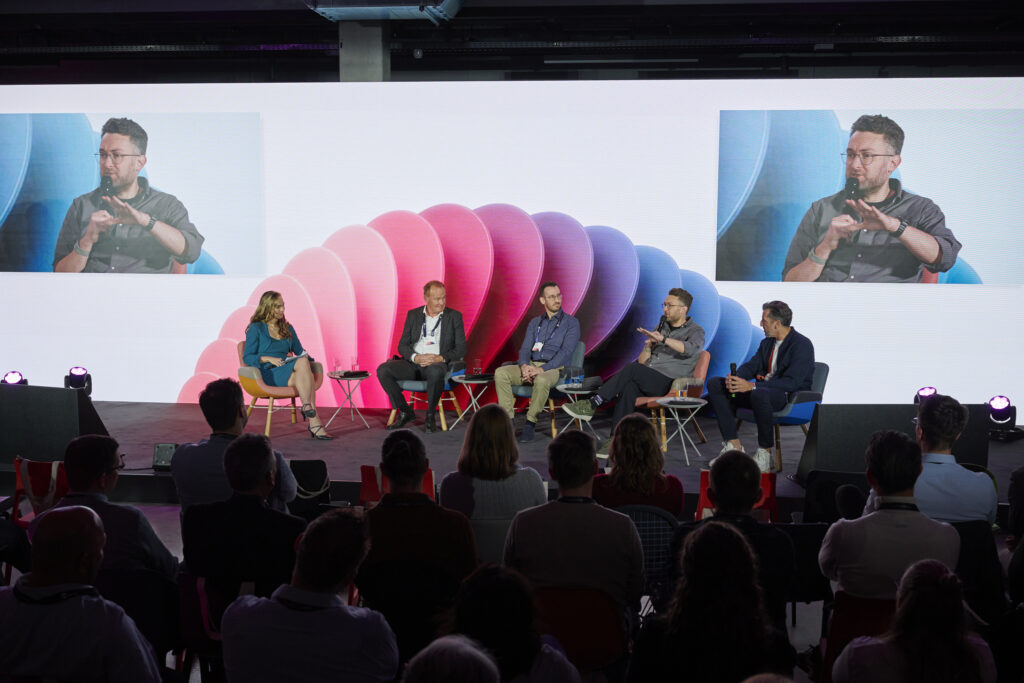
Exactly the insight I had hoped for: the questions asked, the atmosphere in the room, and the topics that really concerned people. One participant talked about how his 15-year-old son has math problems whispered into his ear by ChatGPT. Another described how her daughter argues with ChatGPT: literally, loudly, with arguments. I took these stories with me to the next morning.
In the panel, I also introduced a concept that has been on my mind for years: cultural lag. Typically, technology advances first and culture trails behind. In the case of AI, the order is reversed. We have had science fiction images of artificial intelligence in our heads for decades. It is only recently that the technology has come close to our inner expectations. This makes AI particularly susceptible to hype and storytelling strategies, because we always view it through the lens of these preconceived expectations.
The keynote: “Shaping the future beyond the hype”
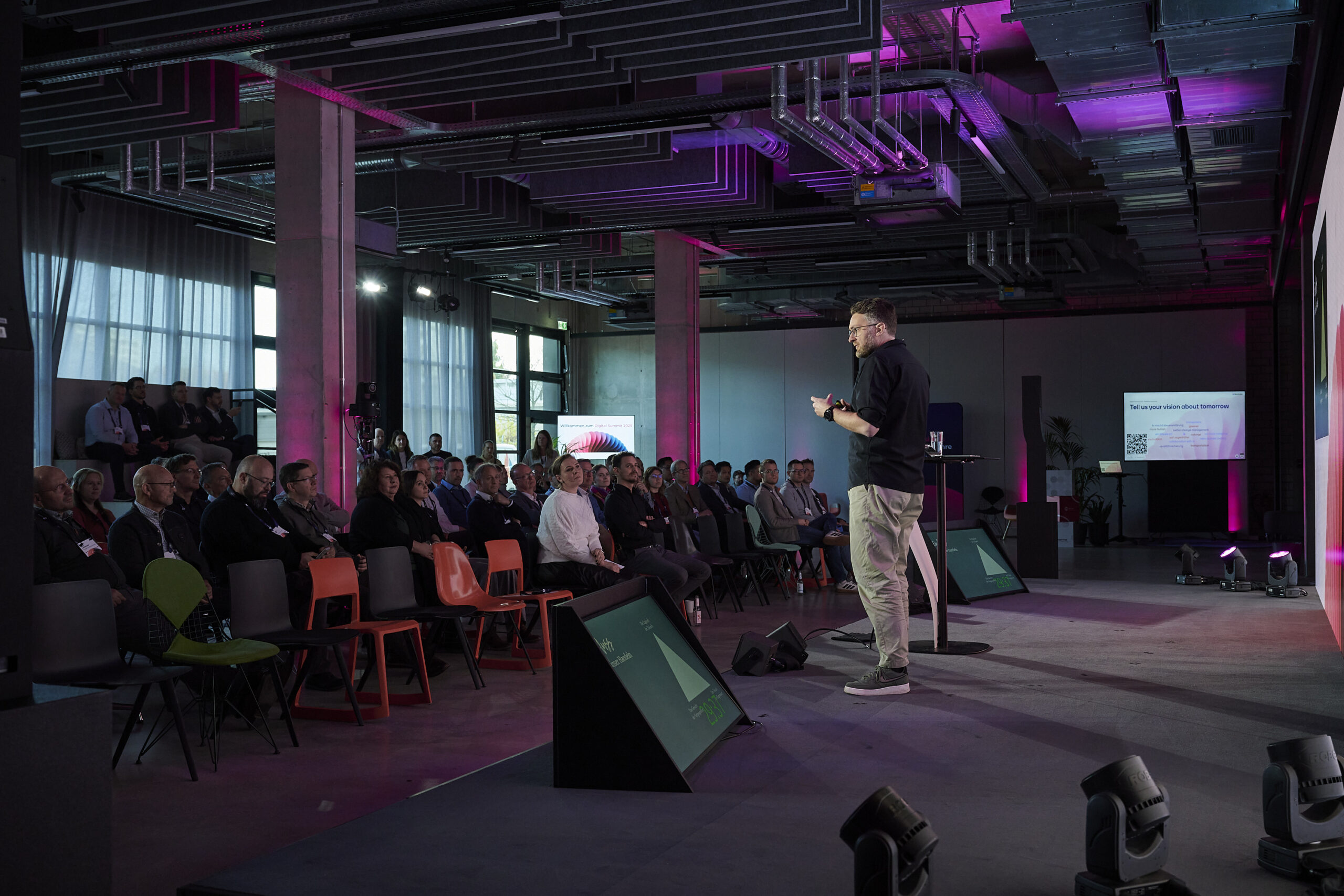
The next morning at 10 a.m.: Opening of the second day, 30 minutes for the keynote.
I started with an observation: “Shaping the future” can be read everywhere at the moment. You can find it on posters, at party conferences, and even on beer labels. When a slogan like this becomes popular, it tells us something about the times we live in: that we want more agency than we feel we have. But what exactly does “shaping the future” actually mean?
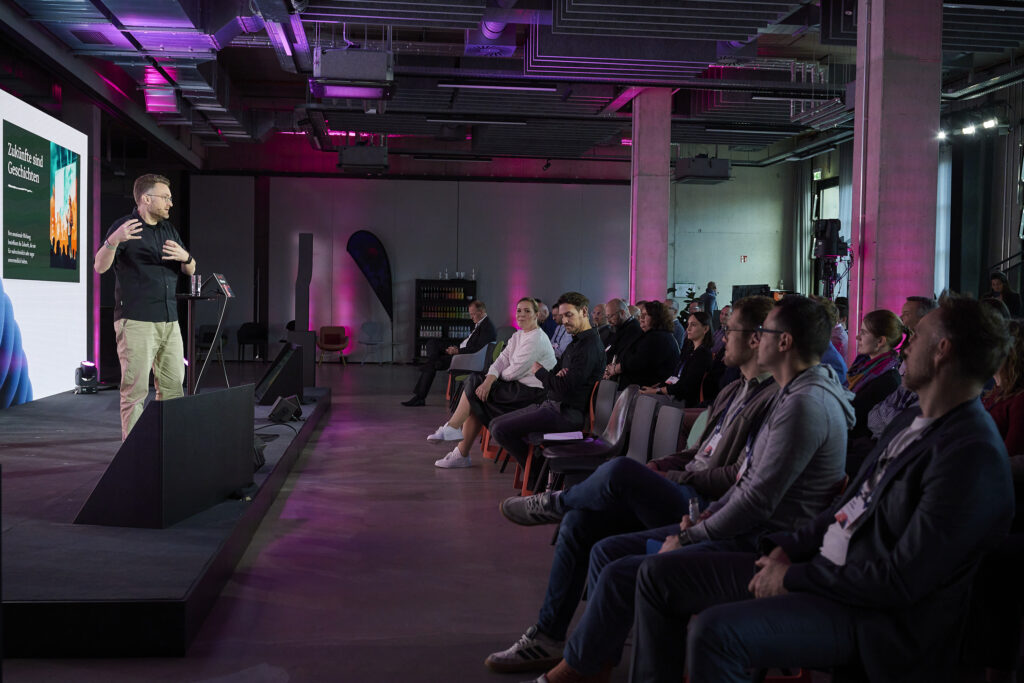
From there, I developed the central thesis: “Futures are nothing more than stories that we tell ourselves and others.”
This leads us to the topic of hype, which is often overlooked in discussions about AI. How does hype arise? A certain narrative is repeated over and over again: this is the future, this will be the next big thing, and everyone has to be part of it. The more people repeat it, the higher the expectations, and the higher the expectations, the more people act on them. This, in turn, heightens the probability of this future becoming a reality. It’s a self-reinforcing cycle that makes the battle over which future narrative is winning so interesting. And so important.
I showed examples of tech entrepreneurs who are driving their future narratives forward with enormous resources: Mark Zuckerberg, Sam Altman, and Elon Musk. They tell exactly the stories about the future that work to their own advantage.
My point: “If we don’t develop our own images of the future, we automatically act in the futures of these men.”
But how do you get out of this? Not through more hype, but through substance. I discussed the efficiency trap: we tend to put AI on top of existing systems, a little faster here, a little more automated there. But new technologies have never just accelerated existing processes; they have changed entire systems. The invention of the elevator did not result in a faster journey from the first to the third floor. The consequence was that we were able to build cities completely differently.
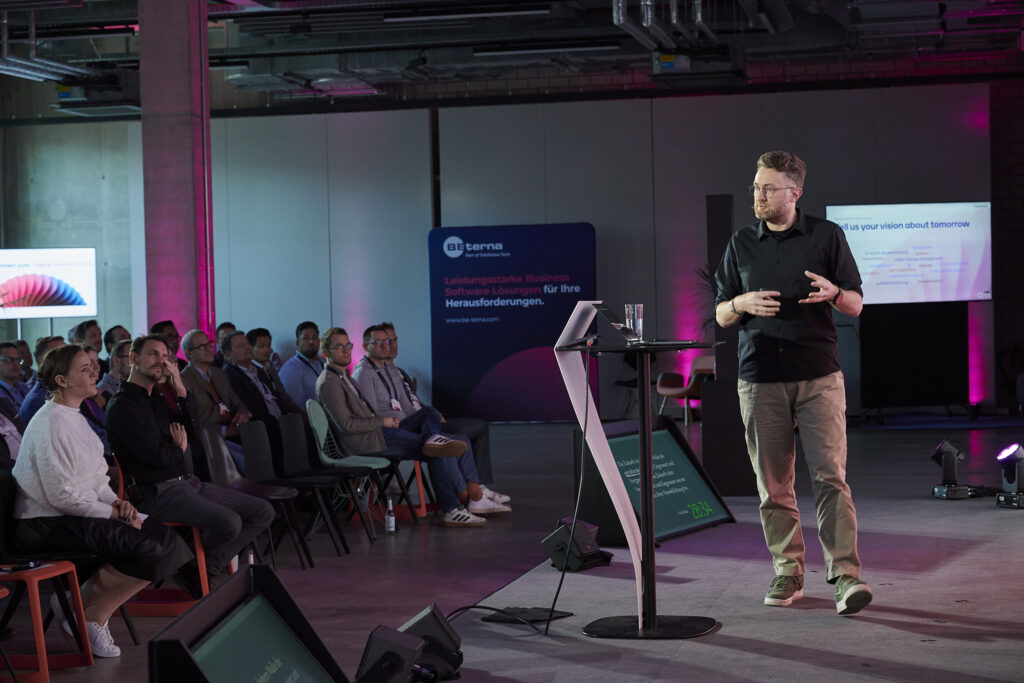
And then: “Words create worlds.” When we constantly talk about “agents” and “AI coworkers,” we build up certain expectations, and occasionally we forget that these are all just metaphors. My invitation to the participants was, therefore, to really delve into the substance in the day’s sessions, not to stop at the metaphors, but to ask, “How does this really work?”
Finally, a concrete exercise: “Imagine it is Digital Summit 2030, and you are invited to present your success here on stage. What do you want to talk about?” And the advice I gave the participants for the day: “Watch out for that tingling sensation. Whenever you get so restless, or something seems strange, something is happening that could be exciting.”
What BE-terna says.
After the event, I received this feedback from the two main organizers Selina Ostermann and Stefanie Wienberg:
“Johannes showed great commitment to the topic and our target group and showed great initiative. He customized his keynote specifically for our event, the participants, and the overall topic. He is open, competent, and brings exciting, future-oriented approaches—we can only recommend working with him, and we will be very happy to come back to him in the future.”
I would like to take this opportunity to thank them and the rest of the team at BE-terna. It was an ideal collaboration for me.
For organizers
If you are planning a keynote, talk to me. Unlike many speakers who arrive with ready-made presentations, I am happy to work with event organizers on a solution that fits their specific context. The intensity of this collaboration depends on your wishes, your time frame and your budget.
Short-term requests are possible. More lead time enables more in-depth preparation and opens up opportunities such as accompanying promotional content.
I give talks on shaping the future, AI and work, and dealing with uncertainty, whether as a keynote, on a panel, or in a workshop. Every event is different; every audience has different questions. And finding that out is the first and most important step for me.
All photos: © Jan Hütz